Sunday, November 26, 2017

GLSEN 1.0


I attended GLSEN 1.0 on the morning of October 2, 2017 at the San Diego Department of Education. The training was held in an intimate environment, in a classroom-sized portable with approximately twenty-five attendees and three facilitators. Breakfast burritos, fruit, and coffee were provided despite the fact that the training was free, which I thoroughly enjoyed.

Although I am not currently placed in an elementary school site, I attended the training that was geared toward elementary students. The reason for this is because throughout all of my experiences working with LGBT youth, educators have not established one specific way of what is appropriate to discuss in the school setting- particularly at the young elementary age.

 In my experiences, even a large majority of those who consider themselves to be liberal believe that students should only be recognized by their birth sex (not their gender identification) and that same-sex relationships are an inappropriate topic to even mention. I attribute this to the damaging legacy that many stereotypes and misconceptions have historically imposed on LGBT communities and their identities. Historically, homosexuality and other forms of sexual or gender deviance have been labeled as perverse or sinful, both of which individuals want to protect their young children form being exposed to. Furthermore, the sex part of homosexuality has traditionally been emphasized more than the relational aspects of it. In our heteronormative society, homosexuality is seen as a sexuality whereas straightness is overlooked or is just seen as "normal."  Discussions surrounding sex being something that Euro-centric cultures began to hide from children beginning during Victorian times, it is obvious why our education system would shun curricula with LGBT content.

Questions Answered:

How can I be a supportive ally to LGBT youth at the elementary age?
How do I discuss bullying, gender roles or family diversity with elementary students? 
How can I include positive representations of LGBT people in the elementary curriculum? 
How do I inspire my elementary students to be kind and speak up when they see bullying?
During the training, the facilitators mentioned that one way to support trans students is to call them by their preferred name and pronoun and to allow them to use gender neutral bathrooms or bathrooms that match their gender identity. Even though they pointed toward specific policies that protect the students' rights in this regard, attendees became argumentative with them. A principal suggested the scenario of a parent who wanted their child to only be recognized for their birth name and sex on campus. This principal stated, understandably, that she would have a really difficult time disrespecting parents' wishes because the student is under twelve. The facilitator simply argued that all they have to tell the parents is that its a law that needs to be followed. This is a shortcoming of the training that I will discuss further in subsequent paragraphs.

Policies that Facilitators Referred to:

Safe Schools Improvement Act
Student Non-Discrimination Act
No Promo No Homo Law


As someone who loves children's literature, I was pleased to look through some of their book suggestions. I think that pointing parents, students, and teachers toward books like these is a great way of broaching a topic in a lighthearted and "in-sexual" way.
Here are some of the books that were on display during the training:


And Tango Makes Three; Board Book; Author - Justin Richardson                When Kathy Is Keith; Paperback; Author - Wallace Wong
Image result for GLSENImage result for lgbt children's literature


During the training, the facilitators explained concrete ways of working with parents who are opposed to having a welcoming environment for LGBT students. They modeled to us how to present the laws and policies to parents smoothly and non-confrontationally. They also showed us how we could explain to the parent the school climate surveys and how it is the job of all educators on campus to support a healthy and safe environment for all students. One of the shortcomings of this training, however, was that the presenters seemed to be out of touch with what it is like to work in a highly conservative school where parents beliefs are grounded in strong religious beliefs that a law or policy could not sway.
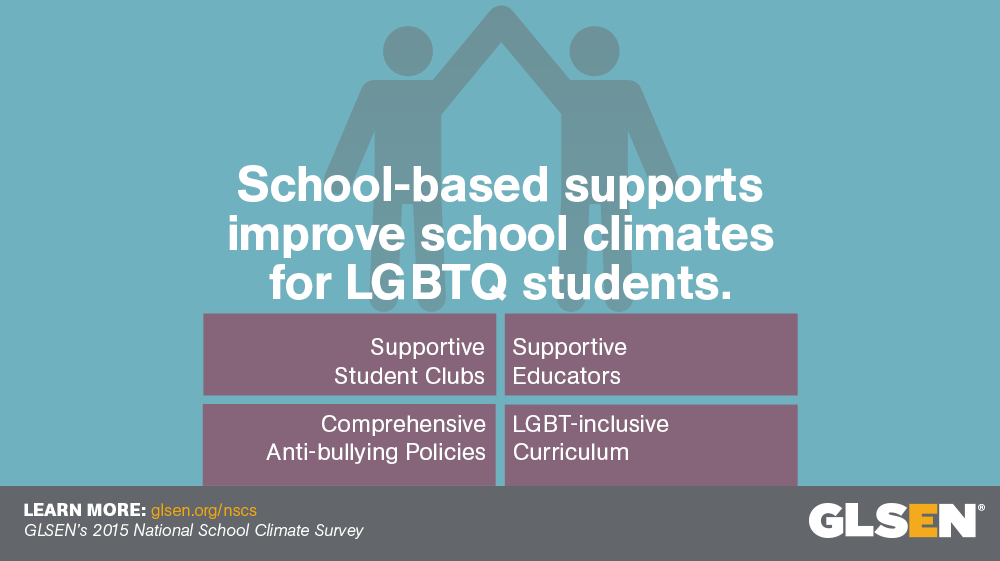
Image result for GLSENImage result for GLSENImage result for GLSENImage result for GLSEN
If I was a principal of an elementary, I would definitely implement the ideals that this group teaches- creating a gender neutral and gender expansive school environment. I am highly aware that it would be easier to implement in certain schools and very difficult in others. Regardless, all teachers should be given trainings on this topic. The way that I would measure its effectiveness would be to administer school climate surveys wherein I asked about harassment based on sex, gender, or sexual orientation.

As a counselor, I will weave the curriculum into my guidance lessons and I will provide trainings for staff on how they can include it into their curriculum also. Some of this includes teaching media literacy by asking students to look at families that they see on television and reflect on how they might be different from their own families. This is not limited to looking at the genders of the parents; students can address that their are different types of homes than are shown in media (apartments, trailers, etc.). The training provided a book with curriculum and specific lessons for students that I can use in my guidance lessons or present to the principal to be taught school-wide by teachers at the beginning of the school day (as PBIS is taught) and eventually integrated into the values of the school. Something that I think would be very beneficial would be to have adult individuals who identify as LGBT come in and share their negative experiences in elementary in front of an audience of parents and educators. This could help to remind parents and educators that their children will become adults one day who will potentially remember what it was like to be either supported or bullied by their communities and what they wish educators and parents would have done to support them when they were in elementary. Teachers are not going to want kids growing up into adults who remember them as the person who would not respect their gender identity. Parents are not going to want their kids growing up to remember them as someone who was contributing to anti-gay bullying rather than protecting them. I think that this could give everyone some helpful perspective.


Image result for GLSEN


Friday, November 24, 2017

Equity Symposium 2017


As a soon-to-be professional school counselor committed to learning best practices in providing equitable access and learning for all students, I was eager to attend the second annual Equity Symposium sponsored by the San Diego County Office of Education (SDCOE). The two-day conference took place on September 7th and 8th, 2017 at the Sheraton Hotel in San Diego and it brought together school and district leaders, teachers, and school counselors to uncover barriers impeding students’ education. This year’s theme was “Mindsets, Relationships, and Innovations” and each of the three keynote speakers addressed these key factors in providing students with equitable supports and opportunities they need to be successful. Attendees sat with other members of their district which allowed for productive conversations with people familiar with the specific student needs, resources, issues of each district in attendance. I loved that this conference was not exclusively for school counselors, although I was surprised that I was the only school counselor in attendance from the San Marcos Unified School District. I loved having the opportunity to connect with principals and teachers from throughout the district, and even the superintendent, brought together with a common vision of equity.   

Tuesday, November 21, 2017

UC Counselor Conference 2017

          Addie Honeycutt   SDSU Masters Candidate in School Counseling, 2018


The University of California Counselors Conference was held this fall at the University of California, San Diego campus.  I was encouraged by my fieldwork supervisor, Ms. Elvia Estrella, to attend this conference to increase my knowledge of supporting high school students in their college applications. The conference was broken up into sessions for new and veteran high school counselors to learn about advising students on the newest iteration of the University of California application.  I was able to attend three sessions throughout the day, all of which were incredibly helpful for an inexperienced counselor!  The sessions are described below, with important takeaways listed for each.

Session 1: Financial Aid the UC Way

Gold and Blue Opportunity Plan: Any family making less than 80,000 will not pay tuition and fees out of pocket at any UC campus

Comparison of costs between UC/CSU:


Total costs to attend a UC campus are only $300 more than a CSU campus.  This is because the UC gives, on average, more grant aid!

GLSEN 1.0 -Creating a Safe Space for LGBT Youth 1.0


GLSEN 1.0- Creating a Safe Space for Lesbian, Gay, Bisexual, and Transgender Youth 1.0  (Secondary Level)


Presented through the San Diego County of Education 
(lunch and beverages were provided 
and this was a FREE event, which was a plus!) Be on the look out for GLSEN 2.0 training in 
the upcoming  months as well as GLSEN 1.0 Creating a Safe Space for LGBTQ students at the 
Elementary Level!
This presentation focused on training participants how to support middle/high school students who are LGBTQ. Together, we can improve the experiences of LGBTQ students!

Who: Presenters: Dennis Nicely-he/him/his
                              Irina Segade-she/her/hers
Target group: School Counselors and educators working with LGBTQ youth in schools

What:                  
1. To emphasize the importance of making schools safe and respectful for all students through staff
    training, GSA's, enumerated anti-bullying policy, and inclusive laws, and curriculum.

2. To explore LGBT terms and become familiar with LGBT contributions to our society.

3. To learn about state and federal legislation that deal with LGBT issues including the
FAIR Education Act or SB 48.

4.To understand the experience of LGBTQ+ students and learn how to be their ally.

5. To explore the issue of "intersectionality" of cultural identities and their relationship to LGBTQ+ discrimination

When: Monday, November 13, 2017  12:30pm-3:30pm
Where: Marina Village Conference Center, Anchor Room (Building D)
Why: To better and support LGBTQ+ students- GLESN believes all students deserve a safe, supportive school environment free of bias-based behavior. Addressing anti-LBGTQ bias in schools makes schools safer for all students, regardless of sexual orientation and gender identity/expression.
GLESN believes that our cultural identities do not function in isolation and it is important to consider those intersectionalities when working with all youth.

Transgender statistics 
Safe Space Kit- complete with posters and stickers!
          Greetings educators! I am here to tell you about the GLSEN 1.0 -Creating a Safe Space for LGBT Youth 1.0 workshop I attended. As a former teacher and future School Counselor, I feel like I still am learning about how I can best support and be an ally to LGBTQ youth. I realized how essential creating a safe space at schools is for LGBTQ students. LGBTQ students need allies, caring adults that are willing to be leaders in their schools, promoting equality and fostering a respectful environment where all students feel welcome each day. I wanted to learn the tools that I can bring to my current school internship site and also to my school site when I become a future School Counselor.

Monday, November 20, 2017

NAMI (National Alliance on Mental Illness)


 Who, What, When, Where, Why

Ways media portrays mental health as a stigma
I attended a training workshop on NAMI (National Alliance on Mental Illness) presented by Erik Villalobos, who is the NAMI California education coordinator. The training workshop was held at the North County Regional Education Center in San Marcos on September 20, 2017. I decided to take advantage of this opportunity because my fieldwork site (Fallbrook Union High School) is creating a NAMI club called Healthy Heart, Mind, and Soul, which promotes mental wellness and awareness. My fieldwork partner and I are taking part in pursuing this club with our supervisor and district therapist. A lot of the time, mental illness goes unspoken or is seen in a negative light, so we are trying to break that stigma and promote mental wellness and to reach out to others if one feels they need help or if they know someone who needs help. Not only that, but a lot of students at FUHS suffer from depression. Getting more insight as to knowing the signs and learning ways to reach out would definitely be beneficial for all students as well as school culture. At this training, there were many students and faculty who attended to start up their own NAMI club at their schools. Four students, the district therapist, my partner and I represented FUHS.

Tuesday, May 17, 2016

Cash For College!

            There were several inspirations for me deciding to pursue a career as a school counselor.  The main impetus was assisting my daughter with the college application process.  In that process I also helped some of her friends that were also desperately seeking guidance on the tedious process of college applications.  Now, having started down the path of receiving a Master in School School Counseling degree, the passion of wanting to help kids get to college has only grown stronger for me.  In order to research this topic further, I attended a “Cash for College” workshop at Vista High School on January 31st to see how school counselors are assisting their students fulfill their college dreams with one of the most tedious parts of the college application process – financial aid forms.  

Sunday, May 15, 2016

Restorative Practices: Circles


Restorative Practices Training by Dana Creek
I attended and will be reviewing the Restorative Practices Training lead by Anthony Ceja. The
workshop took place on March 3rd in our CSP662B class at San Diego State University.  Anthony Ceja is a certified trainer for restorative practices who works for the San Diego County Office of Education, providing trainings at different schools throughout San Diego County on how to incorporate restorative practices into their school environment, structure and discipline policies.  
I chose to review this training because last semester, in one of our first school counseling classes, we had a presentation from a school counselor at one of the practicum sites where she talked about her experience in the field and the particular interventions being used in her school; that intervention being Restorative Practices Circles.  She explained the basic principles behind RP and how it was being implemented in her school; using circles to create a safe school community where students can share their feelings and open-up to their peers without fear of repercussions such as bullying. As well they use circles to create healing within the school when an individual member of the community displays behaviors that harm the community at large, behaviors that would normally get kids sent to detention, suspended or even expelled.  Her words really spoke to me and I’ve been eagerly awaiting this workshop to learn more about Restorative Practices.